Monday, May 01, 2006
Taipei Fine Arts Museum
 Modern, International, Local
TFAM is located in the Yuanshan District of Taipei City. As Taiwan’s first modern art museum, TFAM has maintained high ideals and goals since its inception, continuously and meticulously planning modern art exhibitions, collecting works representative of the development of Taiwanese art, engaging in academic research, actively promoting art education and international exchanges, and nurturing artistic talent. In addition, a wide variety of art events are held for all who enjoy art.
The basis of the museum’s collection is the results of the museum’s over twenty years of research and exhibition activities. More than 3,700 works have been collected, covering the many faces of modern art, and including many of the most representative works from Taiwan. This rich collection provides the museum with a basis for the establishment of various permanent collection exhibits. In addition, the establishment of a digital collection system allows a new turning point for resource integration and cultural reconstruction. The providing of online browsing to the public serves to further humanize and popularize the museum.
The museum adopted a multiple, combined space in order to help attract diverse modern art exhibits. Square windows extend the pleasing scenery while enhancing the dialogue between the museum and the park, and create an environment in which the interior and exterior of the museum reflect each other. In addition, the integrated coffee shop and art bookstore allows the museum to become a place of leisure, deep conversations and a sharing of experience, in addition to its role as a cultural center. Taipei Fine Arts Museum has truly reached its goal of ‘Bringing life to art, and art to life.’

Brokeback Mountain
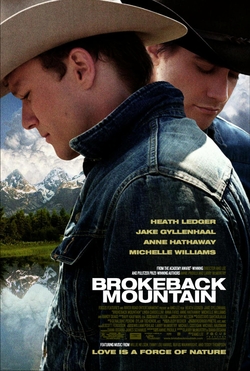 Brokeback Mountain is the star-crossed lovers' story of Ennis del Mar (Ledger) and Jack Twist (Gyllenhaal), two young men who meet in 1963 while on a sheepherding job on the titular mountain, somewhere in Wyoming. The film documents their meeting and the complex relationship over the 20 years that follow.
The two men get to know each other during brief periods at their main camp on Brokeback Mountain, gradually revealing details about their upbringing and outlooks. Ennis, at first the camp tender, soon switches jobs with Jack, riding out daily to where the sheep are pastured. One night, after the two share a bottle of whiskey, he stays at the main camp, sleeping next to the campfire while Jack sleeps in the tent. The fire dies and Jack orders the noisily shivering Ennis into the tent. After a while he takes Ennis' hand, moving it toward his crotch. Following brief resistance from the reserved and cautious Ennis, who then hastily moves Jack into position, the men couple passionately. For the remainder of the brief summer their sexual and emotional relationship deepens.
After the two part ways at the end of their job, Ennis marries his fiancée, Alma Beers (Williams) and starts a family. Jack moves to Texas where he meets Lureen Newsome (Hathaway), whom he subsequently marries.
Four years later, Ennis receives a postcard from Jack saying that he will soon be in town and hopes Ennis will want to see him again. The two men reunite and find their passion is as strong as ever. Jack broaches the subject of creating a life together operating a small ranch. Ennis, haunted by a childhood memory of the torture and murder of a gay man in his hometown, fears that such an arrangement can only end in tragedy. He is also unwilling to leave his family. Unable to be open about their relationship, Ennis and Jack settle for infrequent meetings on camping trips in the mountains.
As the years pass, Ennis's marriage deteriorates. Alma divorces him and takes custody of their children. Jack hopes that Ennis's divorce will allow them to live together at last, but Ennis refuses to move away from his daughters. In scenes of their occasional trips together, Jack's expresses frustration over Ennis' refusal to consider a life together. As the two prepare to part at the end of one trip, the frustrations and fears lead to angry confrontation. Jack admits to visiting Mexico (where Ennis knows men can find homosexual prostitutes) and Ennis threatens him. "What I don't know," he says, "all them things that I don't know would get you killed if I should come to know them."
Jack responds with equal anger over their situation: "We could a had a good life together, a fuckin real good life but you didn't want it, Ennis, so what we got now... is Brokeback Mountain!" he says, and then utters the words that sum up his longing and frustration: "I wish I knew how to quit you."
Several months after that last meeting, Ennis learns that Jack has died. In a strained telephone conversation, Jack's wife Lureen tells Ennis that Jack's death was accidental, the result of an exploding tire, but a montage showing Jack being beaten in the face with a tire iron demonstrates Ennis's conviction that Jack was murdered. Lureen tells Ennis that Jack wished to have his ashes scattered on Brokeback Mountain, and suggests contacting his parents.
Ennis visits Jack's parents, offering to take Jack's ashes to Brokeback Mountain, but Jack's father insists that Jack's remains be buried in the family plot. Jack's mother is more welcoming, and invites Ennis to go upstairs to Jack's boyhood bedroom. There, Ennis discovers two old shirts hidden in the back of the closet. The bloodstained shirts, with Jack's enclosing Ennis' shirt on the same hanger, are the ones the two men were wearing on their last day on Brokeback Mountain in 1963.
At the end of the movie, Ennis opens his own closet to reveal that he has hung the two shirts, this time with his surrounding Jack's, inside the door with a postcard of Brokeback Mountain. With tears in his eyes, Ennis mutters, "Jack, I swear..." before closing the closet door.
Sense and Sensibility
 Sense and Sensibility is a novel by Jane Austen that was first published in 1811.
The story concerns two sisters, Elinor and Marianne Dashwood (Elinor representing "sense" and Marianne "sensibility"). Along with their mother and younger sister Margaret, they are left impoverished after the death of their father, and the family is forced to move to a country cottage, offered to them by a generous relative.
Elinor forms an attachment to the gentle and courteous Edward Ferrars, unaware that he is already secretly engaged. After their move, Marianne meets Willoughby, a dashing young man who leads her into undisciplined behaviour, so that she ignores the attentions of the faithful Colonel Brandon.
The contrast between the sisters' characters is eventually resolved as both find love and lasting happiness.
The hugely successful 1995 film Sense and Sensibility starred Emma Thompson and Kate Winslet as the sisters, and was directed by Ang Lee. Emma Thompson's screenplay took some liberties with Austen's story in the interests of a modern audience's requirements.
The Wedding Banque
 The Wedding Banquet (Chinese: 喜宴)
Wai-tun Gao (Winston Chao) and Simon (Mitchell Lichtenstein) are a happy gay couple living in Manhattan. Wai-tun is in his late 20s, so his Taiwanese parents (Sihung Lung and Ah-Leh Gua) are eager to see him get married and have a child. The early part of the movie is madcap comedy. When Wai-tun's parents hire a dating service he and Simon stall for time by inventing impossible demands. Chinese opera singers are always men, so they demand an opera singer and add that she must be very tall. The service actually locates a 5'9" Chinese woman who sings Western opera. She is very gracious when Wai-tun explains his dilemma. In order to satisfy his parents and present them with a grandchild, he assures them he is going to be happily married soon.
Surprisingly, his parents decide to come to America from Taiwan, together with US$30,000, to hold a magnificent wedding ceremony for their son. Wai-tun dares not tell his parents about his homosexuality, because his father has just recovered from a heart attack, and goes through with the wedding. The heartbreak his mother experiences at the courthouse wedding prepares the story for a shift to drama. The only way to atone for the disgraceful wedding is a magnificent wedding banquet. Among many traditional customs, the blindfolded bride tries to identify her new husband with a kiss on the cheek. Laughter erupts when she chooses an eight-year-old boy. After this wedding of convenience, the bride Wei-wei (May Chin), an artist who cannot pay her rent, forces Wai-tun to have sex with her that night, hoping that he would become straight so she can really become a part of his family. Simon is very upset about the wedding, and his relationship with Wai-tun begins to deteriorate.
Later, Wai-tun learns that Wei-wei gets pregnant. Being angry with her, Wai-tun tells his mother the truth, which shocks his mother. Before the relationship between Wai-tun and Simon gets worse, Wai-tun's father tells Simon secretly that he knows about their relationship, and, appreciating the considerable sacrifices he made for his biological son, takes Simon as his son as well. Simon accepts the Hongbao from Wai-tun's father, which according to Chinese tradition, is a form of admitting the persons to be their children's partners, and promises not to tell any one else that the father knows this: for the sake of family, the father just can't confess it to the public. Later Wei-wei decides to give birth to the baby, and Simon is willing to be the other father of the baby. Wai-tun's parents leave later, with the odd family reconciled.
Pushing Hands
 Pushing Hands (Chinese: 推手)
The story is about an elderly Chinese T'ai Chi Ch'uan teacher and grandfather (played by Sihung Lung) who emigrates from China to live with his son, his American daughter-in-law and his grandson in a New York City suburb. The grandfather is increasingly distanced from the family as he is a "fish out of water" in Western culture and he does not care to participate in the materialistic life style prevalent in the West. The film shows the contrast between traditional Chinese ideas of Confucian relationships within a family and the much more informal Western emphasis on the individual. The friction in the family caused by these differing expectations eventually leads to the grandfather moving out of the family home (something very alien to traditional expectations), and in the process he learns lessons (some comical, some poignant) about how he must adapt to his new surroundings before he comes to terms with his new life.
The title of the film refers to the pushing hands training that is part of the grandfather's T'ai Chi routine. Pushing hands is a two person training which teaches T'ai Chi students to yield in the face of brute force. T'ai Chi Ch'uan teachers were persecuted in China during the Cultural Revolution, and his family was broken up as a result. The grandfather sent his son to the West several years earlier and when he could he came to live with his family with the expectation of picking up where they left off, but he was unprepared for the very different atmosphere of the West. "Pushing Hands" thereby alludes to the process of adaptation to culture shock felt by a traditional teacher in moving to the United States.
Ang Lee
 Ang Lee (Chinese: 李安) (born October 23, 1954) is an Academy Award-winning film director from Taiwan. Lee won the 2006 Best Director Oscar for Brokeback Mountain (2005).
Lee decided to take on a small-budget, low-profile independent film based on Annie Proulx's Pulitzer Prize-winning short story, Brokeback Mountain. The 2005 movie about the forbidden love between two Wyoming cowboys immediately caught public attention and initiated intense debates. The controversies notwithstanding, Brokeback Mountain showcased Lee's skills in probing depths of the human heart. The film was critically acclaimed at major international film festivals and won Lee numerous Best Director and Best Film awards worldwide. Brokeback was nominated for a leading eight Oscars and was the frontrunner for Best Picture heading into the March 5th ceremony, but lost out to Crash, a story about race relations in Los Angeles, in a controversial upset. There was speculation that the film's depiction of homosexuality might have been the reason for the upset. Lee said he was disappointed that his film didn't win Best Picture, but in this his fifth appearance in the Academy Awards, he did win Best Director, becoming the first Asian ever to win the award. http://en.wikipedia.org/wiki/Ang_Lee